Elida Anna Bianchi

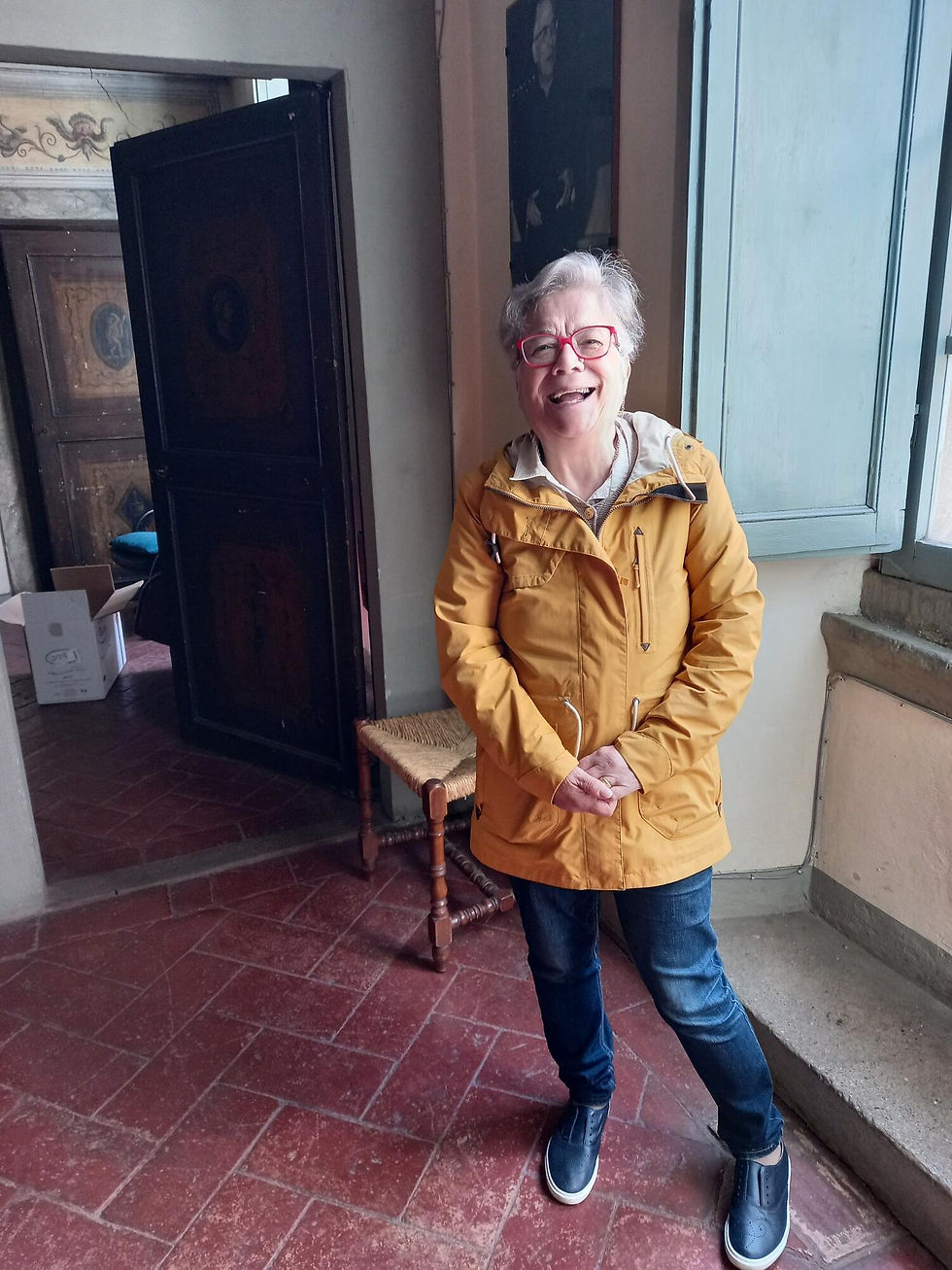
This year, I conducted interviews in the Palazzo Fontana, seat of the Anghiari Cultural Centre (ACS). Here is a description of the ACS by Renato Li Vigni:
ANGHIARI CULTURAL CENTRE
Between earth and sky in Tuscany APS (Social Promotion Association)
With a vision of culture as a driver of development of small villages in the Apennines, we promote the heritage of the territory for a better future for the next generations. Established in 2017, ACS is a non-party, non-profit association for social and cultural promotion, entered in the Third Sector registry.
WHAT WE DO
– VIDEO STORYTELLING AND CINEMATIC CULTURE: a permanent workshop of video storytelling, courses, festivals and meetings to spread cinematographic culture.
– THE TERRITORY OF THE ARETINO-EMILIANO-ROMAGNOLO APENNINES: a permanent workshop of land science under the supervision of Carlo Citter, Professor of Medieval Topography/ UniSI; research and promotion of the archaeological site of Sestino Romana; research on the network of paths and transhumance roads (Communes of Sarsina, Verrucchio, Badia Tedalda, Sestino, Anghiari, Monterchi, Sansepolcro).
– BOOK COLLECTIONS AND DOCUMENTS. In our offices in Palazzo Fontana, we preserve two important book collections: Maurizio De Benedictis – film history and criticism; and Giovanni Caselli – anthropology and archaeology of the landscape.
I was born in Eva Peron in Argentina on the 12th March 1953. My family was always a family of migrants – in 1902 my grandmother on my father’s side, nonna Elvira, was born in Buenos Aires. The family is true anghiarese, but my great grandfather left because of the extreme poverty at the time. How did I come to born in Argentina? Well, my mother had an aunt who, with her husband, moved from Anghiari to Argentina in 1910. They were well-off and travelled back and forth, and, on one of those occasions, they invited my mother, Gabriella, and my father to migrate because, at that time, there was more work Argentina. My parents had an itinerant stall selling haberdashery in markets, but life was hard here after the war. So, they left… they had a good life there. In 1950, for example, they had a fridge; here, in Anghiari, nobody had one, many houses didn’t even have running water. They had a comfortable life – my mother stayed at home with her aunt and my father worked with his uncle installing water pipes and heaters.
In September ’54 my father decided, overnight, to come back to Italy. It was good timing because, when they reached Casablanca, Peron fell and the pesos lost all its value. Fortunately, my father had already changed his into lire. In the meantime, my grandparents had set up a small shop which my mother expanded, changing the style. The house above the shop wasn’t yet ours – at the time we lived at Villa Fiesolina.
I went first to school in Anghiari and then I attended a science high school, Piero della Francesca, in Sansepolcro, which still exists – a good school with Latin, literature, history as well as science subjects. Then I enrolled at the University in Florence, in biology, a subject I really enjoyed, but I left before graduation. I chose to help my parents … it was my choice, I wasn’t under any pressure from the family.
I married in 1976, this year is our 50th wedding anniversary. We have two children, Elena and Federico. Federico is married and, at the moment, lives in Figline because he is fixing his house in Anghiari. He works in his uncle’s company, Forval – they make gold/silver jewellery. Elena lives in Anghiari – she studied foreign languages and now works in the export office at Tratos Cavi, a company that makes cables, optical fibres, selling all over the world.
My bond with Anghiari was born in childhood, playing in the street with friends. When I was attending university in Florence I lived there during the week, but I would come back for special occasions, like during Carnival – Don Nilo would call us, the Carnival started in the church … we were young, we attended the Oratorio, the parish youth club inaugurated around 1966, and there was a cinema – Don Vittorio had bought a projector.
The Church has always been important for the town, particularly thanks to Don Nilo. He was a visionary, and he had a long-term vision for young people…. He also understood the economic needs of the town. I have a personal example: in the ’60s,’70s there wasn’t real poverty – if one owned some land it was possible to survive with the produce, exchanging in a kind of circular economy – but he encouraged my brothers to start a small business producing jewellery… so the youngsters didn’t have to leave home, to go away looking for work.
I also feel a deep bond with the town because my mother, father, everybody in the family, my grandfather, had always been very aware of other people’s needs. When there was something to do, we had to go, go, do, do.
From an early age, I have done volunteering. It started in 1967: there was the antique weapons fair, I was 14, and they asked me to help at the cashier. From then, if someone has called me, I have always said yes …perhaps it was a predisposition, then it became almost a vocation. Volunteering is very important for the people here – have you noticed how many volunteering associations there are? It’s an innate passion…. I met my husband on a soccer field – he was a player and, from there, the passion for the Baldacci Bruni started – a small team … we tried to involve boys in a youth team which is still active after 44 years thanks to the help of others. Without this help, you can’t achieve anything – the practical support is more appreciated than a money donation.
The special thing about Anghiari is friendship, beauty, and belonging, to a sport association, to the devotion to the Madonna di Loreto…. I still raise my eyes and see something I have never seen before – I marvel at a sight, every day I rediscover… it is part of the soul. I close my eyes and I can see again my mother sitting outside the shop embroidering – I really liked it…. I see her in myself, almost like a symbiosis …. It is special that people who are not with us anymore are still here; it is special that people are always welcoming, ready to answer – if possible, we do things for each other. It is a kind of beauty that in big cities doesn’t exist anymore, and here too is waning, slowly slowly, with the disappearance of people of a certain age…. I hope that this special attitude is carried along by the new generation … if we teach our children to be kind, to be always welcoming, to love the town and to recognise if something is wrong.
The town has always felt safe to me …you could go out in total tranquillity and serenity … we played soccer, went back home, we never felt in danger, and if a passer-by saw us in any danger they would help. Belonging means this, feeling protected. A sense of security also comes from having someone to ask if I need help with the shopping bags…
The landscape is wonderful thanks to the position of the town high up in the centre of the Valtiberina. The anghiaresi have a reason for their campanilismo – the view of the valley, the fields green, in all colours according to the various cultivations, the woods, and, on a clear day, it is possible to see the Monti Sibillini covered in snow. It is all very beautiful.
I go for long walks. It might seem grim, but I often go to the cemetery to see the people who are not here anymore…memories resurface. I think about nonnino, my grandfather – he still lives in me, this man with a vast education; he was from an almost aristocratic family, with a feeling for culture. I travelled a lot as a child with him- he took us to France, Hungary, we toured Europe, seeing ancient things … the beauty of the past lives on. I remember his face lighting up when we went to antique markets in France. Then there is Novella Ceppodomo who lived opposite us … she was involved in Tovaglia a Quadri. Thanks to her I learnt the history of some families – she told me about palazzo Testi [the current location of LUA, the Free University of Autobiography] where 30 families, including hers, lived. …beautiful memories.
I remember going to kindergarten, Novella standing in the street at the door would call us by name. Teacher Linda taught us wicker weaving…. And we played…hide-and-seek, hopscotch, and when there were a lot of us, we used a long rope and skipped all at the same time… we gave each other nicknames, Plum, Peach, Pear. And then all the games with a ball, throwing it against a wall and taking turns at catching it, dodgeball. We had so much fun!
I have always filled my spare moments doing something – sewing, knitting, but mainly reading. My grandmother read to me – One thousand and one nights, Gulliver’s Travels …. I’m reading in French L’étranger, and I like crime novels, Camilleri, and Grisham who speaks of justice as it should be.…. Above all, with age, I can reread passages of I Promessi Sposi, La Divina Commedia… and, every time, the phrases come back to me. I also like philosophy, history – as I grow older, the things that formed me as a person.
I miss my shop, the human contact – of course I wanted clients, but it was mainly the contact, sitting on a bench, meeting people. I have now founded ‘The girls’ den’. I have another shop across from the old one and we meet there every Saturday at 5.30 pm – we talk about what’s happening in town, we exchange tips, addresses … a beautiful hour and a half to deal with the closing down of the shop I loved so deeply.
With the closing down of small neighbourhood shops so much is lost – they are the richness of a village, but also of a suburb in a city. There’s the loss of interpersonal relationships – in a local shop like mine people came in to ask advice, perhaps regarding an object, but sometimes, in this digital world, old people asked for help on how to do things on the phone, the computer… small shops were fundamental … also, because we knew each other, we kept an eye on misbehaving youngsters.
When someone came into my shop my welcoming was innate, warm, authentic… it is my nature. I hope we can preserve authentic encounters… the conversation, speaking honestly, looking each other in the eyes.
A few days later, I did a further interview with Elida to hear more about the shop that she owned for 44 years. We met in the ‘shop’ opposite where she stores unsold goods and which has also become a repository of unwanted items from local businesses – she can’t say ‘no’. Her ex-shop is now the office of a ‘weddings planner’ (in English) company.
The shop was opened by nonno Lorenzo and nonna Elvira in 1950. They already had an itinerant stall… then they bought a very small shop, 20 square meters. At the beginning, they sold articles for sewing and knitting, elastic strings, plates and glasses. Then, they bought a neighbouring warehouse and a tinsmith shop that had closed, and then, in 1963, they fixed the apartment above the shop.
My grandfather left the shop to my mother. Like others in the family, she had a diploma – my grandfather believed in girls’ education …but he saw in her a special talent in understanding the market. She started selling underwear, clothes, shirts, skirts and my father dedicated himself to gift items and toys. The shop went on for many years and did very well – there was a lot of work, but very satisfying, not only financially, but also because the clients were happy. We sold on instalments and did promotions even if our name was already established… the quality was always high, but with an eye to the price.
We kept the haberdashery, needles for hand and machine sowing and for repairing the nets for olive harvesting, buttons, crochet hooks, perfumes. We sold exercise books for children passing by on their way to school. We had dispensers with brilliantine, shaving cream, hairspray, floor polishing wax and bleach; customers came with their own bottles for refills – we recycled, without throwing anything away. The big change came with Moplen, when plastic substituted everything – the end of a world.
The decision to close was a result of the prevalence of supermarkets and the arrival of e-commerce. Online buying killed us and the Covid pandemic contributed a lot – with shops being closed, customers got used to buying online. We were able to stay open during the pandemic because we had items for children, but we still lost a lot. The year after, the title of the Tovaglia a Quadri performance was ‘Ci Amazon tutti’ [they kill all of us; ammazzare = to kill]. Nobody in government understood the importance of the network of the local shops – we provided a service to people, our windows lighted up the streets, we saved beauty, without us there is more vandalism, delinquency. Taxes are not proportionate with the size of the shop, we pay like the big ones in a fashionable street in Rome.
The Piazzetta delle legne [the name given by the community to the small piazza outside the shop] was named like that because of the special Wednesday sale – it was a separate market where people stocked up with embers produced in Toppoli and small bundles of twigs and firewood. It discontinued in the early ’60s because the producers bought Ape cars and would do home deliveries.
My shop had a strategic position – on one side, you look up to La Propositura [the main church], on another, there is a view of the main square from where everyone could see me, sitting on my bench.
© 2025 Ann Game · © 2025 Equinozi
Elida Anna Bianchi