Stefanie Risse

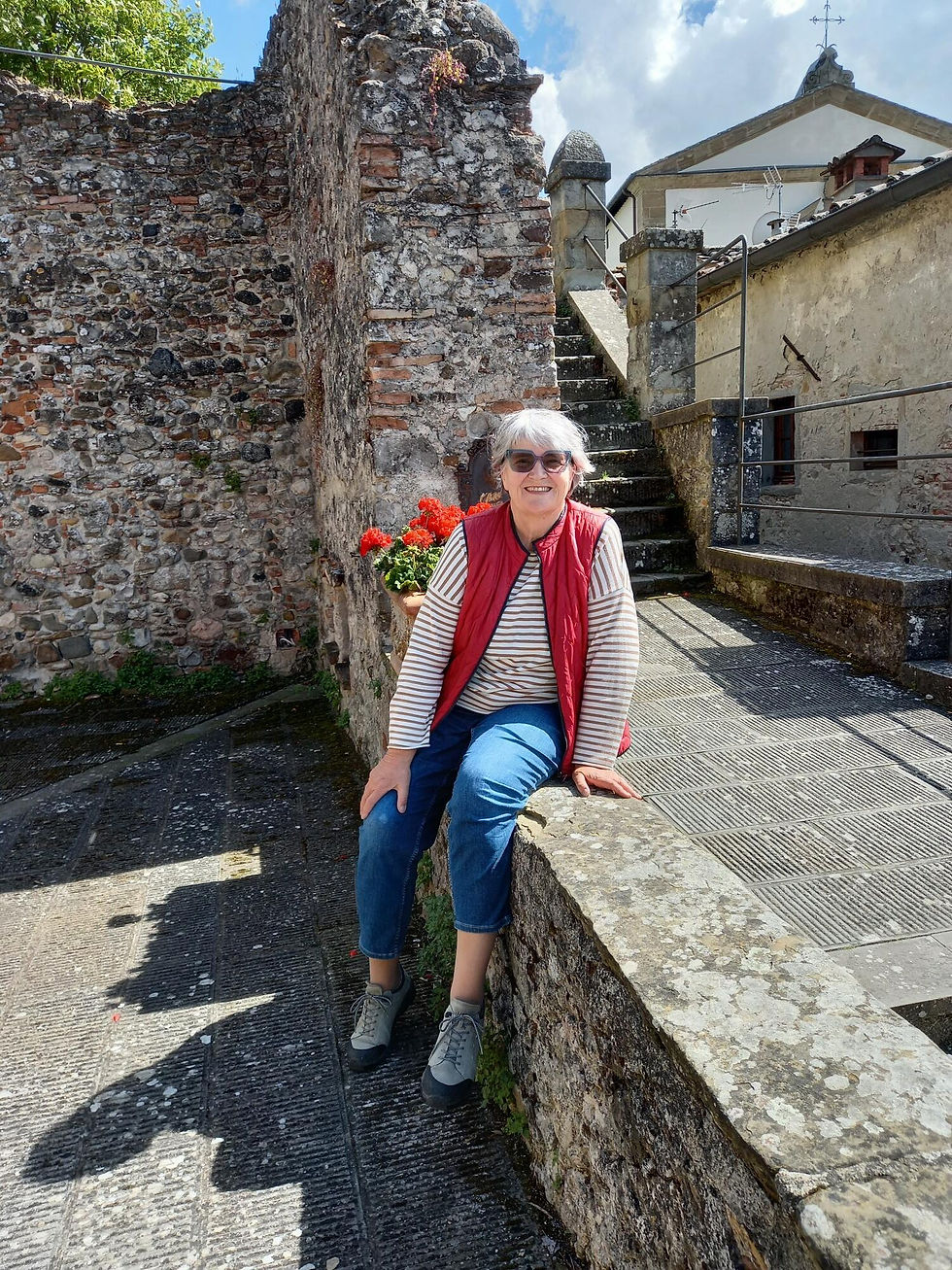
Stefanie has been involved with LUA, the Free University of Autobiography, since its foundation in 1999. Since then, with Anna Noferi, she has coordinated il Circolo di scrittura autobiografica a distanza (the autobiographical writing at a distance circle). While I was in Anghiari this year, I attended their weekly meetings where hand-written letters on various autobiographical topics are read. I interviewed Stefanie in Palazzo Testi, the new location of the university.
I come from Germany, West Germany to be precise. I was born in October 1959 in a small town near Frankfurt on Mein. We were a quiet family, father, mother, sister Susanne, 7 years older than me, with a small pretty house, a garden, a pussycat. Our grandparents and other relatives lived far away – I only met them when they came to visit or when we travelled in our Beetle to see them in Loerrach. My father was 50 when I was born, he had been married previously and had two daughters, had fought in Russia and been imprisoned, and came back only in 1949, ten years before my birth.
I spent my childhood in Schwalbach, a village near Frankfurt. I had a happy childhood; I was cheerful and active, but the carefree period ended at the end of primary school. Exceptionally for that time, I finished when I was 9 and started high school in Kronberg. It was a difficult passage: in the same year I had a bad accident – a dog bit me in the face, and my father became ill with cancer. It was the ’60s and the student protests reached our school and our family too. I remember desperate fights during which my sister and I blamed our parents for what happened during the nazi period. It was only in the ’60s and ’70s that the truth about the Holocaust was reported in the media and discussed in schools.
The atmosphere in our family was often difficult, especially with my mother who didn’t get along with me, and nor I with her! Luckily, when I was barely 15 years old, I found my first love, Till, with whom I had some unforgettable trips. At the age of 16, with backpacks on our shoulders and very little money in our pockets, we hitchhiked to Spain. In that period my best girlfriends were Eva Maria, Angela, Ingrid, Eva with whom I had endless adventures and misadventures and laughter.
In the last years of school, I developed a passion for studying and, luckily, the school system allowed me to concentrate on the subjects I liked the best – literature and foreign languages, but also political science. And then, I enrolled at the Freie Universitaet in West Berlin. It was September 1978, I was 18, I packed my bag and left for West Berlin. At the time, I travelled on the train line that crossed East Germany, with strict border control. But once I reached Berlin, I could breathe the air of freedom.
The time in Berlin was a period of experiments on all fronts. Politically, for me, the Green movement was just born, the anarchist movement organized squatters, especially in the suburb of Kreuzberg. I tried pottery and step dancing courses. The break-up with my ‘old’ friend Till was painful, but, in the first semester, I fell in love with Bruno. I am proud to say that I supported myself during my studies – I worked as a shop assistant in a stationary store, then as a journalist at the city desk of the left-wing paper TAZ. I studied English, journalism, sociology, philosophy, and finally graduated with a thesis in history and literature. They were years full of deep and diverse experiences, but it all had to finish… in the end I felt a desire for a life in the countryside, fresh air, a new beginning.
At that age, things happen more or less by chance … you don’t realize that they can be decisions for life. Life seems open and unlimited, full of possibilities and paths to follow. My friend Eva Maria and I, just for fun, decided to leave Berlin and have new experiences somewhere else. We considered various options, and then… Italy! We didn’t really know the country, but we liked the music, Lucio Dalla, Gianna Nannini, and the political movement Lotta Continua; I loved Umberto Eco and had studied Carlo Ginzburg; we saw plays by Dario Fo and Franca Rame; we went to Osteria Numero 1 in Kreuzberg, ate spaghetti and pizza and drank chianti. So, from many points of view, Italy felt like the right destination.
The three of us -Eva Maria, Bruno and I – began to learn the language, make initial contacts in Italy…. we bought an old yellow VW Polo and then we left for Italy. We knew someone near Arezzo and from there we looked for a house, which we found in the hills near a small town, Monte San Savino. It was cheap because it was hard to get there, by car and then 15 minutes on foot.
I lived there from 1985 till 1989, not working as a German teacher as I had planned. I did lots of jobs – picking tobacco, grapes, olives in the farm near us; it was hard work but eating with ‘the family’, the farmers who owned our house and our first employers, was unbeatable and it paid well. In the evenings, there were celebrations, the communist party Feste dell’Unità, we danced; without the hospitality of this marvellous family, the Rosadinis, we wouldn’t have survived! Saturdays and Sundays, I worked in a disco, during the week I taught German and English privately.
I met Professor Vittorio Dini who gave me work at the Università del Magistero di Arezzo – I translated and published his books in German, books on agro-pastoral cultures, on the Madonna del Parto and the Ancient Mothers. I was still writing for TAZ and, over the years, published 3 books on Tuscany and translated many others. I was also building my present career as a tour operator. I had started to rent some houses in the Valdichiana area to tourists from Berlin; I then became an agent for a Swiss holiday homes agency and, since 2000, I have been working for a big Danish agency for holiday homes in Tuscany and Umbria.
In 1987, having created a small agency for holiday houses, I opened an office in Arezzo, in the old city centre. It was there that I found friends, Daniela and Perdita, and met my future husband, Fabio, who was an architect in the Arezzo city offices. Our relationship developed and, in 1990, our daughter Marlene was born. It was by chance that, in 1993, we found a house in Anghiari. I was 33; we moved on the 1st July 1993, with a lot of enthusiasm but in very modest financial circumstances. After years of renovation, we created OUR PERFECT HOME. We see the sun rising in the morning and going down in the evening. We have a pretty garden, 2 cats and a dog.
Marlene grew up here, she had the privilege of attending the San Lorenzo kindergarten and then she went to the small primary school in Tavernelle, now closed, a quiet and reassuring environment, with committed and loving teachers.
We made friends, especially with some residents of the hamlet of Upacchi where many young families from Italy and Germany were renovating houses. I found all I needed in Anghiari, so I gave up going ‘to town’ to Arezzo for my errands.
Now, to my connection with the Libera Università dell’Autobiografia. I actually met Saverio Tutino, the founder of the Archivio Diaristico Nazionale di Pieve Santo Stefano, in 1994. I knew of him, he was famous, and I saw him at the post office in Anghiari … I approached him and told him about my interest in life stories. We remained in contact and then, in 1999, I was one of the founders of LUA – I was at the first meeting along with Saverio, Duccio Demetrio and Franco Talozzi!
I am still involved with LUA now, coordinating the Circolo di scrittura autobiografica a distanza (the autobiographical writing at a distance circle). This is a project based on corresponding by hand-written letters. I initiated this project and, yes, I am proud of it! In Anghiari, there is a group who meet every Tuesday afternoon to read letters on autobiographical topics that arrive from all over Italy and also from abroad, and we answer each of them. This job enriches me a lot, I have learnt much from other people’s lives and I have established very deep relationships with different people, especially with Anna.
[See photo of the group, Il Circolo, outside Palazzo Testi, with their most recent publication, Il mio credo.]
In the past I sang with the choir; I go to the library; and always to the Southbank concerts in summer – a huge gift. The cultural events have become so numerous that it isn’t easy to keep up with everything on offer! Anghiari, and also Sansepolcro, are like magnets attracting willing and creative people from all over the world. Aside from the anghiaresi with their traditional celebrations, many other activities have sprung up: yoga, dancing, walking groups, cycling races, painting, reading, music, ceramics, theatre.
I have always tried to promote ecological thinking. Unfortunately, tobacco is still grown in the valley; a harmful plant in itself, it consumes a lot of water, especially during the torrid summers, and the growers use a lot of pesticides, hence polluting soil and water … not everybody, not even here, has an ecological awareness. Anghiari is the only town in the valley that hasn’t regulated the use of pesticides, and the incidence of cancer is unfortunately very high here.
For a while I thought about going back to Germany – despite all these years in Italy, it is hard still being ‘la tedesca’ (the German). I often miss my language, the food, daily reliable relationships, punctuality, this kind of thing. But then I realized that my life is here! The beauty I can enjoy here, every day of the year, walking through the streets, crossing the piazzas, looking around in all directions… from sunrise to sunset – I don’t want to give up all this beauty. I also like walking, discovering the San Francesco pilgrim paths and these wonderful landscapes surrounding us.
I am approaching my third age and I am happy that I can do it here. Times have changed, the world is a risky place. I don’t want to travel anymore, I want to live intensely every precious moment of my daily life, with my small family and dear friends and neighbours.
© 2025 Ann Game · © 2025 Equinozi
Stefanie Risse